
What Is an AI Receptionist? A Complete Guide for UK Businesses

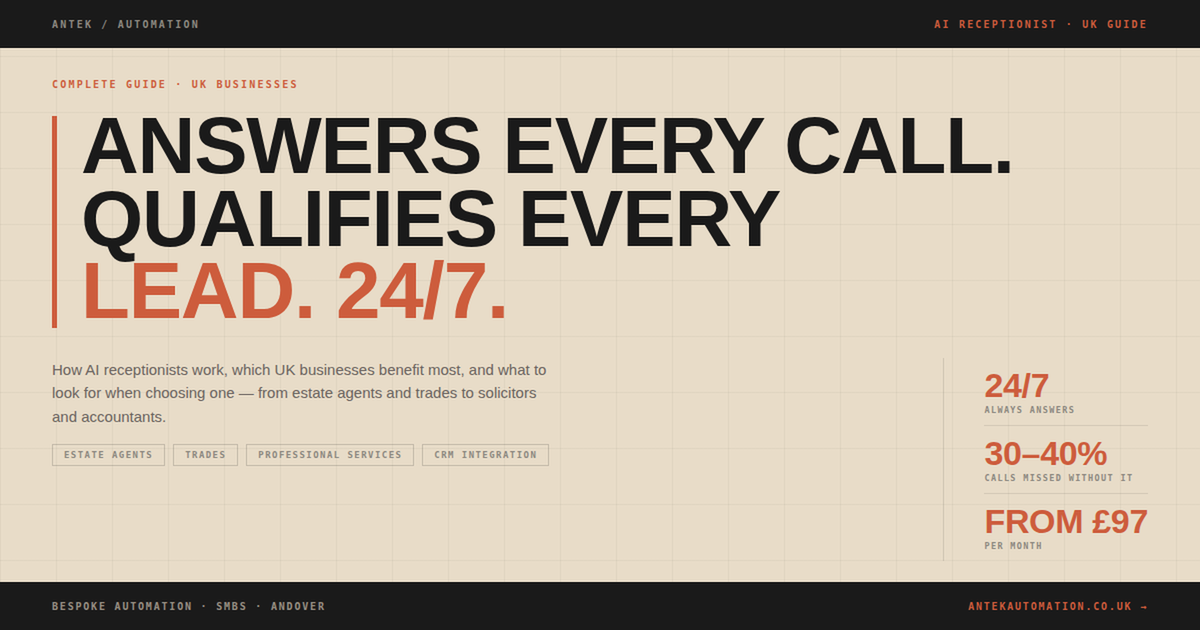
An AI receptionist is a voice AI system that answers your phone calls, qualifies leads, books appointments, and integrates directly with your CRM and calendar. It handles inbound enquiries 24/7 without hiring additional staff, and it sounds natural enough that most callers assume they are speaking to a human.
For estate agents juggling viewing requests, vendor enquiries, and tenant calls across multiple branches, an AI receptionist removes the bottleneck. For trades managing emergency callouts and quote requests, it ensures no job is missed. For professional services firms handling high-value client enquiries, it provides instant response without the cost of a full-time receptionist.
This guide explains how an AI receptionist works, which businesses benefit most, and what to look for when choosing a system.
How Does an AI Receptionist Work?
An AI receptionist uses natural language processing to understand what a caller wants, respond appropriately, and take action based on that conversation. The technology sits behind a phone number and answers calls as they come in, just like a human receptionist would.
When a call arrives, the system greets the caller and asks how it can help. It listens to the response, processes the intent, and either answers the question, books an appointment, qualifies the lead, or routes the call to the right person. All of this happens in real time, with no delay or robotic menu prompts.
Behind the scenes, the AI connects to your calendar, CRM, and other business systems. When it books a viewing or logs a lead, that information flows directly into your existing tools. You do not need technical knowledge to set this up. Most AI voice assistants are configured once and then run autonomously.
The system improves over time. As it handles more calls, it learns common questions, refines its responses, and adapts to your business processes. You can update scripts, add new services, or adjust call routing rules without developer support.
What Can an AI Receptionist Do?
An AI receptionist handles the repetitive tasks that occupy most of your front-desk time. It answers common questions, qualifies inbound leads, books appointments, and routes urgent calls to the right team member.
For estate agents, that means taking viewing requests, capturing vendor details, answering questions about properties, and booking valuation appointments. The AI can check availability in your calendar, confirm the appointment with the caller, and send a confirmation email or SMS.
For tradespeople, it means logging job requests, asking qualifying questions about the work required, and either booking a site visit or passing urgent jobs to your mobile. It can also provide quotes for standard services and take payment details if needed.
For solicitors and accountants, it means capturing intake details, qualifying new client enquiries, and booking consultation calls. The AI asks the right questions to determine whether the enquiry is a good fit, then routes high-value leads to a partner or senior consultant.
The system also handles overflow. During peak periods, when your team is on other calls or out of the office, the AI steps in. It never goes to voicemail, never puts a caller on hold indefinitely, and never misses an enquiry.
Why UK Businesses Are Adopting AI Receptionists
The core driver is cost. A full-time receptionist costs between £20,000 and £28,000 per year, plus holiday cover, sick leave, and training. An AI receptionist costs a fraction of that and works around the clock.
The second driver is missed calls. Most small businesses lose 30 to 40 per cent of inbound enquiries because no one is available to answer. That might be because the phone rings during a viewing, on a job site, or after hours. Every missed call is a potential client going to a competitor.
The third driver is scalability. When enquiry volume spikes, whether due to a marketing campaign, seasonal demand, or a sudden increase in interest, you cannot hire overnight. An AI receptionist scales instantly, handling ten calls or a hundred without degradation in service quality.
Local businesses in Hampshire, from estate agents in Winchester and Southampton to trades in Basingstoke and Andover, are adopting AI receptionists to handle enquiry spikes without hiring additional staff. The technology has matured to the point where implementation is straightforward and ROI is measurable within weeks.
AI Receptionist for Estate Agents
Estate agents live and die by responsiveness. A buyer calls about a property, and if no one answers within a few minutes, they move on to the next listing. A vendor calls to book a valuation, and if the line is engaged, they call a competitor.
An AI receptionist solves this by answering every call instantly. It can handle viewing requests by checking your calendar, confirming availability, and booking the appointment on the spot. It can capture vendor details, ask qualifying questions about the property, and schedule a valuation visit. It can answer basic questions about listings, opening hours, and fees.
The system integrates with your property management software, so every lead is logged and every appointment appears in the right diary. If a call requires a senior negotiator or branch manager, the AI routes it through. Otherwise, it resolves the enquiry without human intervention.
For lettings managers, the benefit is even greater. Tenant enquiries often come in bursts, particularly when a new property is listed or when students are searching for accommodation. An AI receptionist handles that volume without additional headcount, ensuring no lead is lost and no tenant waits on hold.
AI Receptionist for Trades and Home Services
Tradespeople are rarely at their desks. They are on site, in the van, or up a ladder. That makes answering the phone difficult, and missing calls means missing jobs.
An AI receptionist takes the call, logs the job details, and either books a visit or escalates urgent work to your mobile. It can ask qualifying questions to determine scope, location, and urgency, then provide an estimated timeframe or quote if you have set parameters for standard jobs.
For emergency work, the AI can route the call immediately or send an SMS with job details so you can decide whether to respond. For routine work, it books the appointment and updates your calendar. Either way, the caller gets an instant response and you get a qualified lead.
The system also reduces admin burden. Instead of returning calls at the end of the day to confirm appointments or answer basic questions, you start each morning with a clean list of booked jobs and qualified enquiries.
AI Receptionist for Professional Services
Solicitors, accountants, and consultants face a different challenge. Inbound enquiries are often complex, high-value, and time-sensitive. A poor first impression or a missed call can cost tens of thousands in lost revenue.
An AI receptionist ensures every enquiry is captured and qualified. It asks the right questions to determine practice area, urgency, and client needs, then books a consultation or routes the call to the appropriate fee earner. For straightforward queries, it provides information about services, fees, and process.
The system is particularly valuable for firms handling intake from multiple channels. Whether the enquiry comes by phone, web chat, or contact form, the AI applies consistent qualification criteria and ensures nothing falls through the cracks.
For US law firms handling criminal defense, DUI, immigration, or personal injury cases, AI receptionists for law firms have become essential for intake automation. The AI captures case details, assesses urgency, and books consultations without requiring a paralegal or intake specialist to be on call.
Virtual Receptionist vs AI Receptionist
A virtual receptionist is a human working remotely, usually for multiple clients. They answer calls, take messages, and forward enquiries. They provide a personal touch but are limited by working hours, capacity, and cost.
An AI receptionist operates 24/7, handles unlimited concurrent calls, and costs significantly less. It integrates directly with your systems, so data flows automatically. It does not take breaks, call in sick, or need training on every new process.
The trade-off is nuance. A human receptionist can handle complex or emotionally charged conversations better than an AI. But for the majority of inbound calls, which are routine and transactional, the AI is faster, cheaper, and more reliable.
Some businesses use both. The AI handles first-line enquiries and routine bookings, while the virtual receptionist steps in for escalations or high-value leads. This hybrid model captures the benefits of both without the cost of full human coverage.
Common Objections and Misconceptions
The most common objection is voice quality. Business owners worry that the AI will sound robotic and put callers off. Modern AI voice systems sound natural, with intonation, pacing, and conversational flow that most callers do not question. If voice quality is a concern, ask for a demo. You will hear the difference.
The second objection is cost. Business owners assume AI is expensive or requires a large upfront investment. In reality, an AI receptionist typically costs less per month than a single day of receptionist wages. Setup is included, and there are no hidden fees for call volume or integrations.
The third objection is complexity. Business owners worry that they will need technical expertise to configure and maintain the system. Most platforms are designed for non-technical users. You provide the information about your services, availability, and preferred responses, and the system handles the rest. Updates are simple and can be done through a web interface.
A related concern is what happens when the AI cannot answer a question. The system is programmed to recognise when it is out of its depth. In those cases, it either routes the call to a human or takes a detailed message and flags it for follow-up. No caller is left stranded.
AI Receptionist vs IVR and Chatbots
An IVR, or interactive voice response system, is the press-one-for-sales menu that most people hate. It is rigid, frustrating, and often leads to dead ends. An AI receptionist is conversational. It understands natural language, so callers can speak normally instead of navigating a menu tree.
AI chatbots handle text-based enquiries on your website or social media. They are effective for simple questions and lead capture, but they cannot handle phone calls. An AI receptionist is the voice equivalent, designed specifically for inbound calls.
Some businesses deploy both. The chatbot handles web enquiries, and the AI receptionist handles phone calls. Both feed into the same CRM, ensuring every lead is captured regardless of channel.
Which Businesses Benefit Most from an AI Receptionist?
Any business that receives regular inbound calls and cannot afford to miss enquiries will benefit. Estate agents, trades, and professional services firms are the most common adopters, but the technology works for any business with predictable enquiry patterns.
High call volume businesses benefit from the scalability. If you receive dozens of calls per day, an AI receptionist removes the bottleneck and ensures every caller gets through.
Businesses with after-hours enquiries benefit from the 24/7 availability. If clients or customers call outside office hours, the AI captures those leads instead of sending them to voicemail.
Businesses with seasonal demand benefit from the flexibility. If your enquiry volume spikes at certain times of year, you do not need to hire temporary staff. The AI handles the surge without additional cost.
Businesses with lean teams benefit from the automation. If you are a sole trader or a small team stretched thin, an AI receptionist removes the constant interruption of phone calls and lets you focus on billable work.
How to Choose an AI Receptionist
Start with voice quality. Request a demo and listen to how the system sounds. If it sounds robotic or unnatural, look elsewhere.
Check integrations. The AI should connect to your calendar, CRM, and any other tools you use daily. If it cannot integrate, you will end up with duplicate data entry and missed leads.
Ask about customisation. The system should reflect your brand, your processes, and your services. Generic scripts do not work. You need a provider who will configure the AI to match how your business operates.
Understand the pricing model. Some providers charge per call, others charge a flat monthly fee. Make sure you know what is included and whether there are additional costs for setup, integrations, or call volume.
Finally, ask about support. If something goes wrong or you need to update the system, you should be able to reach someone quickly. Avoid providers who hide behind ticket systems or offshore support teams.
Next Steps
An AI receptionist is not a futuristic concept. It is a practical tool that small and mid-sized businesses across the UK are using right now to capture more leads, reduce costs, and improve customer experience.
If you are losing enquiries to missed calls, paying too much for reception staff, or struggling to scale during busy periods, an AI receptionist is worth evaluating. Book a free demo to see how an AI receptionist can handle your inbound calls and capture more leads without adding headcount.